
How the Iran strike will hit the US economy
What to expect during the conflict in Iran

Operation Epic Fury started on February 28. Since then, the situation has shifted rapidly. We need to look at the hard data before the noise of the headlines takes over.
Just ten days ago, the geopolitical landscape of the world changed fundamentally. What started as a coordinated effort to dismantle nuclear infrastructure has spiraled into a regional conflict, reaching the highest levels of the Iranian government. We are no longer just talking about a series of airstrikes, we are witnessing a complete restructuring of power in the Middle East that will have direct, lasting consequences for your wallet, your investments, and the global economy.
Over the last week, we have seen:
The death of Supreme Leader Ali Khamenei confirmed.
The effective closure of the most important energy chokepoint on the planet.
A surge in oil prices toward levels we have not seen in years.
If you feel like the ground is shifting beneath your feet, you are not alone. But in times of chaos, the best thing we can do is stay grounded in the facts. We need to discuss exactly what is happening on the ground, why the markets are reacting with such volatility, and what this means for the price of everything from the gas in your car to the bread on your table.
If this is your first time here, join 39,000+ investors to get updates like this in your inbox by subscribing:
An island of stability
Before we dissect the current geopolitical collapse, let us acknowledge the elephant in the room: military conflict and supply chain disruptions create the kind of volatility that most investors are simply not prepared to handle. While energy markets and global equities are currently struggling to find a floor, physical real estate remains a cornerstone of wealth creation in America.
That is where Kiavi comes in.
Your next investment is waiting to be built.
Kiavi is the nation’s largest lender to residential real estate investors, financing more than 100,000 flips, rental properties, and new builds across the country.
From first-time investors to seasoned pros, Kiavi’s AI-powered platform empowers you with the capital, confidence, and speed you need to build wealth through real estate.

Build your future. Build your next investment with Kiavi.
The Power Shift in Tehran
To understand where we are going, we have to look at how we got here. On February 28, the United States and Israel launched a massive joint military operation titled Operation Epic Fury.
The goal was specific: To destroy Iranian offensive missile capabilities and dismantle the infrastructure that was reportedly weeks away from achieving nuclear capability. You can find the official briefing on the scope of this mission here.
However, the scale of the operation ended up affecting far beyond infrastructure.
In the initial waves of the attack, a decapitation strike was carried out in Tehran. It was confirmed shortly after that Supreme Leader Ali Khamenei was killed during the bombardment of his compound. This was a monumental shift. For the first time since 1989, Iran was left without its ultimate authority.
While the initial few days were marked by confusion, the situation stabilized on the political front very recently. On March 8, the Assembly of Experts officially appointed Mojtaba Khamenei, the son of the late leader, as the new Supreme Leader of Iran. This move was clearly intended to project a sense of continuity and strength, but it had the opposite effect. It has only intensified the resolve of the current administration in Washington to push for further change.
Meanwhile, there’s a massive power vacuum that is only just beginning to be filled.
Even with a new leader in place, various factions within the Iranian military and the Revolutionary Guard have been acting independently, launching retaliatory strikes against US bases and neighboring allies. This is why the conflict did not end with the initial strikes. We are now ten days in, and the chaos is expanding. Commercial flights across the region have been grounded, and the risk of a wider regional war is higher than it has been in decades.
The Chokepoint of the World
While the headlines focus on the military strikes, the real economic war is being fought in a narrow stretch of water known as the Strait of Hormuz. This is the only sea passage from the Persian Gulf to the open ocean, and it is the artery that keeps the oil pump of the world beating. Roughly one fifth of the global crude oil and liquefied natural gas flows pass through this waterway every single day.
The situation here is escalating from a threat to a reality.
Even though a lone Greek tanker was spotted exiting the strait recently, the channel is effectively sealed for the vast majority of commercial traffic. Shipping operators are simply not willing to take the risk. War risk insurance has been cancelled or priced so prohibitively that it makes the transit economically impossible for most fleets. In response, the US government has moved to provide up to 20 billion dollars in maritime reinsurance to try and restore confidence, but so far, the flow of energy remains a trickle compared to its usual volume.
This is the perfect storm for energy prices.
Oil jumped in the first 48 hours of the conflict, then ripped into March 8 and 9 with intraday spikes nearing 120 dollars per barrel. Brent crude touched a high of 119.46 dollars, while West Texas Intermediate hit 119.43 dollars. When the supply of millions of barrels of oil per day is threatened, the market panics first and asks questions later.
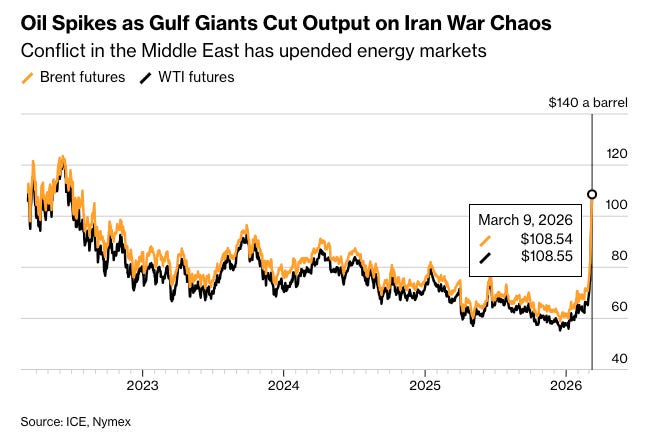
The Federal Reserve has previously estimated that every ten dollar jump in the price of oil adds 0.2 percent to inflation. With oil up nearly thirty dollars in ten days, we are looking at a massive inflationary shock that could force the Fed to keep interest rates high for a lot longer than anyone expected.
Do you think the Fed will delay slashing rates due to these new developments?
The Cost of Living Crisis
The price of crude is an abstract figure. What most people focus on is the concrete impact: the price of gas at the pump, which is already hurting. The national average for a gallon of gas in the United States has jumped to roughly 3.50 dollars, an increase of nearly fifty cents in just one week. In places like California, drivers are already seeing prices well above that. You can track the latest gas price movements and the impact of the conflict here.
But the real danger to your household budget is not just the gas. It is the fertilizer and the broader supply chain.
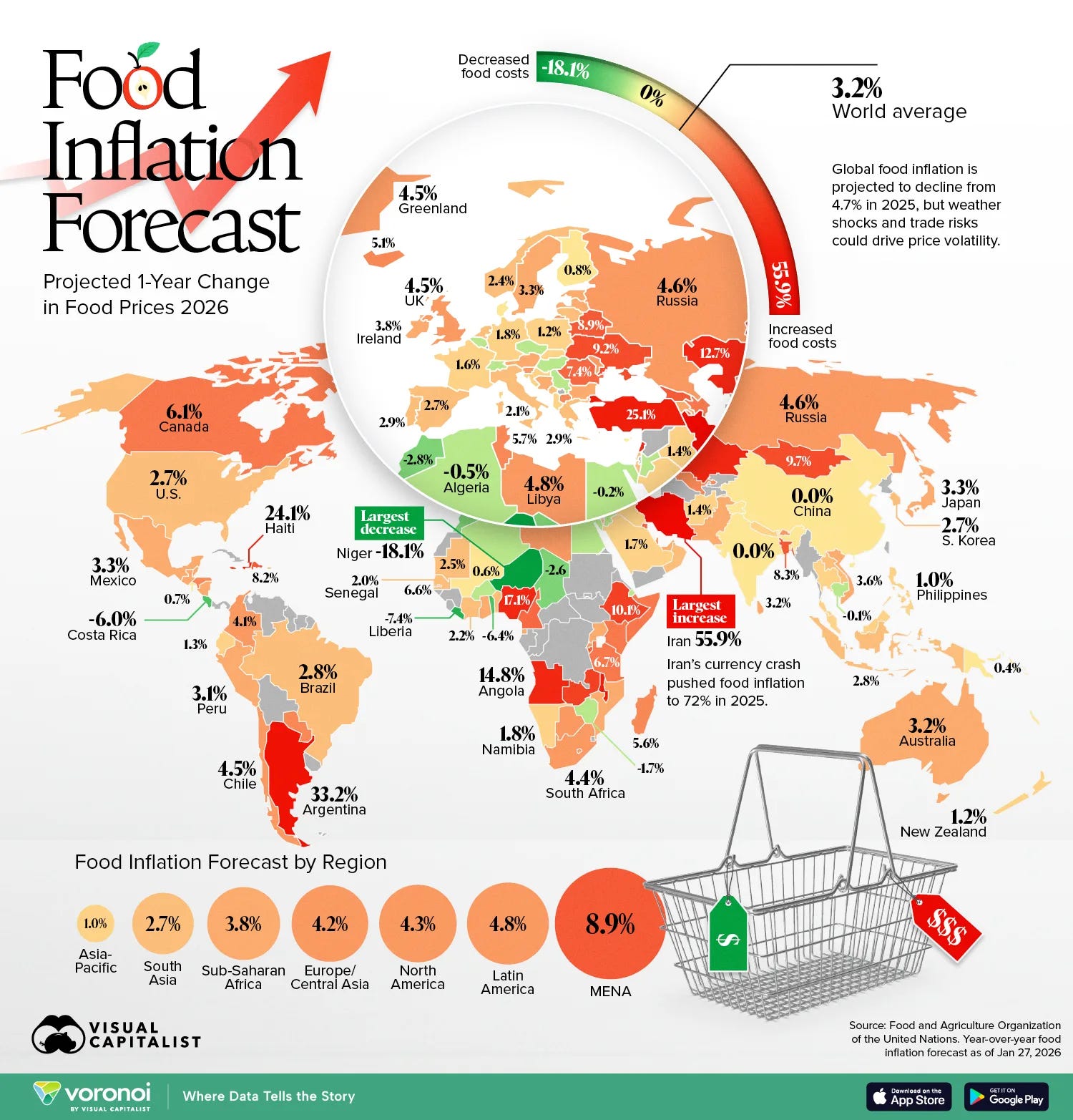
The Persian Gulf is a primary hub for the production of nitrogen-based fertilizers. Since the conflict began, fertilizer prices have seen significant increases as exports are stalled at the strait. This timing could not be worse for American farmers who are preparing for spring planting. If fertilizer prices continue to stay at these levels, the cost of corn, wheat, and soy will follow. This means your groceries, your bread, and your meat are all about to get more expensive. North American food inflation was already projected to hit 4.3 percent in 2026, and this conflict is stoking that fire.
The Stock Market and the Midterm Cycle
So, where does this leave us as investors? It is very easy to look at the chaos and want to sell everything to hide in cash. But history tells a very different story.
While geopolitical events cause short term pain, the market is incredibly resilient. Historically, six months after a major geopolitical crisis, stocks are on average five percent higher. We saw similar panics during the early days of the conflict in Ukraine in 2022 and during the initial stages of the pandemic in 2020. In every single case, the initial shock was met with a recovery as the world adjusted to the new normal.
We also have to remember that we are in a midterm election year.
Historically, 2026 was already expected to be a volatile year. Since 1950, the average intra-year pullback in a midterm year has been 17.5 percent, which is much higher than the 11 to 13 percent we see in other years. We are seeing that play out right now as global stocks tumble and energy prices skyrocket. However, the data also shows that stocks have never been lower one year after a midterm bottom. The average return in the twelve months following those lows is over 31 percent.
The reality is that there is always a reason not to invest.
In 2020, it was a global pandemic.
In 2022, it was record breaking inflation.
In 2024, it was the fear of a recession that never quite arrived.
Now, it is a conflict in the Middle East.
Each of these events felt like the end of the world at the time, but for those who stayed the course and kept their long term perspective, the numbers worked out in their favor.
I understand that this is a lot to process. We are talking about the death of a long standing world leader, the threat of global energy shortages, and a sudden spike in the cost of living. It is sensitive, it is scary, and it affects every single one of us.
But panic is not a strategy.
The best thing you can do right now is to look at your budget, ensure you have an emergency fund that can handle higher energy costs, and avoid making emotional decisions with your portfolio.
The financial impacts of these events are often temporary, even if they feel permanent in the moment. We are watching a historical shift in real time. While the road ahead looks bumpy, the economy has survived worse in the past. Until then, stay informed, stay rational, and stay invested in your long term goals.
If you found this breakdown helpful, please like this post and restack it. It helps the newsletter grow tremendously.
Share this with a friend who is feeling overwhelmed:
I will be monitoring the situation daily and providing updates as the data changes, and I’ll see you next week.
–– Graham
Do you think a nuclear conflict will affect this time differently ?
I’m also curious about a prolonged War campaign execution. Doesn’t the extra military spending affect the economy at large since the administration is in fact requesting approval for much more funding? We’ve started the year with Venezuela, currently $30 billion into what seems at the moment the prelude to WW3, and if we make it out alive, “Cuba’s next,” said Trump.