
Bitcoin invited Wall Street in and now it moves like a tech stock
Why BTC is no longer a safe haven – and how your strategy needs to change

It’s a hard time for crypto investors.
The narrative has shifted violently. Just a year ago, Bitcoin was hailed as the best-performing asset of the decade. It was the digital gold that would protect us from inflation, the hedge against reckless monetary policy, and the inevitable future of finance.
Today, the tables have turned. Bitcoin is falling, down 44% from its all-time high. Investors who bought the top are facing liquidation. Even Michael Saylor, the man who owns roughly 3.4% of all Bitcoin in existence, is reportedly billions of dollars underwater on his holdings. The sentiment has swung.
I have been here before.
I was making videos about Bitcoin when it was $1,000. I watched it climb to dizzying heights, and I watched it crash to $3,200 when nobody wanted to touch it. I have researched every claim, from “it’s totally worthless” to “it’s going to $1 million.” But you can’t base your investments on the hot takes of the latest expert on the block. Opinions come and go, but the numbers tells a different story.
Now that people are panic-selling, we need to look at the data and have an honest conversation about what is actually happening. This sell-off isn’t random or even retail panic. We’re seeing a structural shift, and it’s driven by five specific catalysts.
Once you understand the mechanics behind the crash, you will understand why the next move matters more than anything that has happened so far. By the end of the article, I’ll also outline how exactly I plan to respond.
The Flight to Quality
Before we dissect the crypto collapse, let’s acknowledge the elephant in the room: volatility is the price you pay for asymmetric upside. But not every asset class requires you to stomach 80% drawdowns. While digital assets are currently struggling to find a floor, physical real estate remains a cornerstone of wealth creation in America.
That is where Kiavi comes in.
Your next investment is waiting to be built.
Kiavi is the nation’s largest lender to residential real estate investors, financing more than 100,000 flips, rental properties, and new builds across the country.
From first-time investors to seasoned pros, Kiavi’s AI-powered platform empowers you with the capital, confidence, and speed you need to build wealth through real estate.

Build your future. Build your next investment with Kiavi.
The Anatomy of a Sell-Off: 5 Catalysts
We are currently witnessing a perfect storm. It is rarely one thing that crashes a market: it’s a confluence of factors that amplify each other. Right now, we have five distinct catalysts driving prices lower.
1. The Risk-Off Rotation
Investors are rotating money out of speculative assets and into safe havens. This sounds simple, but it has serious consequences for volatile assets like Bitcoin. When interest rates are high or economic uncertainty rises, holding non-yielding assets like Bitcoin comes with a high opportunity cost.
You don’t get a dividend for holding Bitcoin.
You don’t get interest.
You only get price appreciation.
Fears that the AI sector might be in a bubble, or that stock valuations are stretched are causing the stock market to wobble. When this happens, liquidity dries up.
The narrative till now has been that Bitcoin is an uncorrelated trade. But in reality, it trades like a high-beta tech stock during liquidity crunches – its correlation with the Nasdaq 100 is as high as 0.8.
We’re seeing a flight to safety, and Bitcoin isn’t seen as safe any more. It’s risky.
2. The Return of the Strong Dollar
Most people buy Bitcoin as a hedge against currency debasement. The thesis is simple: “ The government is printing money, the dollar is losing value, so I need an asset with a fixed supply.”
But what happens when the dollar gets stronger?
When the DXY (US Dollar Index) rises, it acts as a wrecking ball for risk assets. A stronger dollar makes it more expensive to buy Bitcoin for anyone holding foreign currency, and it reduces the urgency for domestic investors to hedge.
Recently, the dollar has shown renewed strength, and the inflation hedge narrative is also under attack for Bitcoin.
3. The ETF Death Spiral
The launch of Bitcoin ETFs was a massive boon, unlocking billions in institutional capital. However, ETFs are a double-edged sword. When you buy a Bitcoin ETF, the issuer must purchase the underlying Bitcoin to back your shares. This creates buying pressure and pumps up the price.
But it works in reverse, too. When investors panic and sell their ETF shares, the issuer must sell the underlying Bitcoin to match the outflows. Here’s what happens:
ETFs selling creates mechanical selling pressure regardless of the price.
Then retail investors get scared and sell their ETF shares.
The ETF issuer then sells Bitcoin into a falling market, driving the price down further.
This triggers more fear, more selling, and more liquidation.
This death spiral turns into a feedback loop that amplifies standard market corrections into full-blown crashes.
4. No more Good News
Markets run on optimism.
A year ago, we had a list of catalysts that gave people hope: the approval of crypto ETFs, the Halving, even talk of a Strategic Bitcoin Reserve. Investors were buying the rumor and backing it with money.
Now the rumor has become news, and the news has been sold. The ETFs are here. The Halving has passed. The regulatory landscape has stalled, with critical cryptocurrency legislation hitting road bumps in an election year. There are also fears that a “blue wave” this year could further hamper the growth of Bitcoin.
Some people say Bitcoin isn’t political. Maybe in the larger scheme, the vision is to have a “free” currency that governments can’t tamper with. But in the short run, governments can make or break the trends that determine its price.
There is currently the lack of a next big thing to drive the narrative. Without a clear catalyst on the horizon to push prices to $250,000 or $500,000, short-term speculators are exiting their positions to chase yield elsewhere.
5. A Total Loss of Conviction
Perhaps the most damaging factor is psychological. Investors are losing faith in the digital gold narrative.
In 2025, Gold rallied roughly 50%. Bitcoin struggled in the same period.
If Bitcoin is supposed to be the superior version of Gold, why is it failing to perform during a period of geopolitical instability and monetary uncertainty? Deutsche Bank recently noted that the selloff signals a “loss of conviction” rather than a broken market.
When the correlation between Bitcoin and gold drops, it should be a good thing. But in this context, it’s being interpreted as Bitcoin losing its way. It isn’t acting like a safe haven. It’s acting like a dead weight.
If you want to understand the mechanics of building wealth, join 39,000+ others who get key insights like this in their inbox every week – for free:
The Institutional Divide
To understand where we go from here, we have to look at how the smartest money in the room views this asset. The divide is stark.
On one side, you have the value argument, led by Warren Buffett.
Buffett has famously stated he wouldn’t pay $25 for all the Bitcoin in the world. His reasoning is rooted in productivity. Farmland produces food and factories produce goods. Bitcoin produces nothing. To Buffett, it’s a gambling token where you are simply hoping the next guy pays more than you did. His late partner, Charlie Munger, was even more brutal, calling it “rat poison” and comparing the trading of cryptocurrencies to trading turds.
Nobel laureates like Eugene Fama share this view. Fama predicts that Bitcoin has a high probability of becoming worthless.
On the other side, the institutional narrative has shifted dramatically among modern financiers who are going through a late conversion.
Jamie Dimon, the CEO of JPMorgan, once called Bitcoin a fraud. Then he compared it to “smoking” saying that everybody has a right to it but that he wouldn’t recommend it. Today, his bank allows clients to invest in it, and analysts at his firm have suggested it may have better long-term appeal than gold.
Larry Fink, the CEO of BlackRock (the world’s largest asset manager), went from calling Bitcoin an “index of money laundering” to calling it a legitimate financial instrument with the potential to outperform the internet. Ray Dalio went through a similar transition.
When the people who control the plumbing of the global financial system shift from “it’s a scam” to “it’s an asset class,” you have to pay attention. This doesn’t guarantee the price goes up tomorrow, but it does suggest that the infrastructure for the next bull run is being backed by institutions, regardless of the current price action.
Do you side with Warren Buffett and Charlie Munger – or do you think they were wrong about a technology that they didn’t understand?
Historical Context: We have been here before
If you are new to crypto, a 45% drop feels like the end of the world.
If you’ve been here for a decade, it’s just a Tuesday.
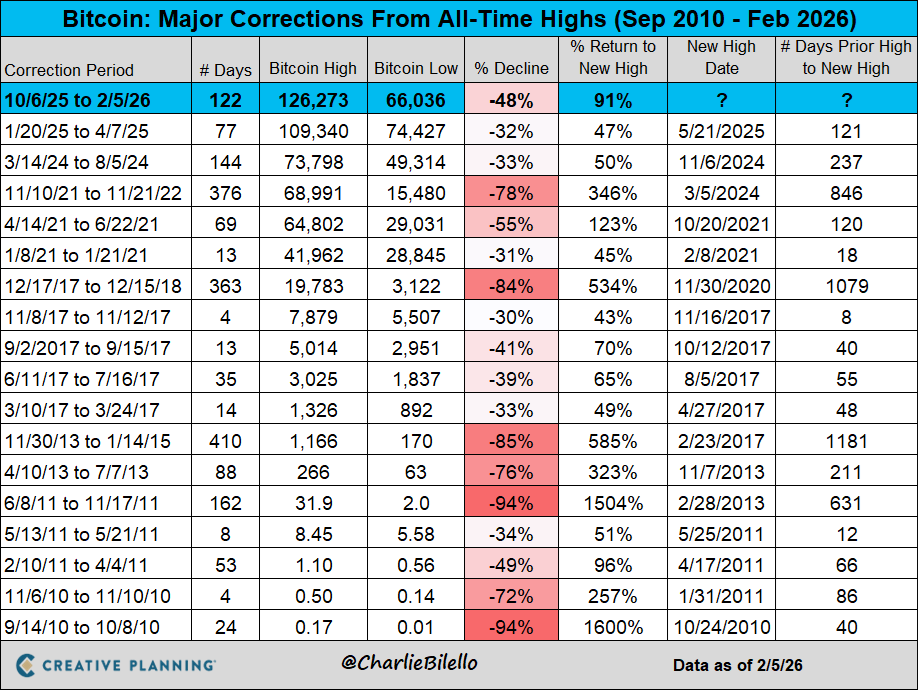
It’s crucial to zoom out. Despite the recent crash, Bitcoin is still up significantly over the last five years. But the path to those gains has been rocky:
2011: Bitcoin fell 99% after the Mt. Gox hack.
2013: It fell 83% from its high.
2018: It fell 83% again during the crypto winter.
2020: It fell 50% in a single month during the COVID crash.
In every single one of these instances, the prevailing narrative was that “Bitcoin is dead.” But in every instance, those who sold the bottom lived to regret it, and those who held (or bought) were rewarded.
The Bitcoin 4-Year Cycle is a theory that suggests the market moves in predictable phases centered around the Halving. We see:
Accumulation
Parabolic expansion
A bubble, and then
A brutal crash that resets the market.
We are likely in the reset phase. This is the period where tourists leave the market, leverage is flushed out, and coins move from speculators to long-term holders.
However, this doesn’t mean the pain is over. Stifel analysts have predicted a crash to $38,000. History suggests we could go lower. But history also suggests that these are the moments where generational wealth is actually created. Speaking of generational wealth, let’s talk about one of the largest Bitcoin holders on the planet.
Why MicroStrategy Won’t Collapse
There is a pervasive rumor circulating that Michael Saylor is going to get margin-called and be forced to dump 3.4% of the Bitcoin supply onto the market, sending the price to zero.
Let’s put this to rest: Michael Saylor cannot get liquidated in the traditional sense.

MicroStrategy does not buy Bitcoin on margin using standard exchange leverage. They use convertible debt. Here’s how that works:
Investors give MicroStrategy money. Saylor uses that money to buy Bitcoin. In exchange, the investors get a bond. At the end of the bond’s term, the investor can choose to be paid back in cash or converted into MicroStrategy stock.
There is no liquidation price where a broker forcibly sells his Bitcoin if the price hits $40,000 or $30,000. The risk isn’t a sudden liquidation – the risk is that if Bitcoin stays low for years, Saylor might have trouble raising new money or might have to dilute existing shareholders to pay back the bonds.
It’s a long-term corporate finance risk, not a short-term trading risk. The fear of a Saylor Dump is largely overblown panic.
The Strategy: How to Survive the Volatility Tax
So, what do you do? Do you sell and cut your losses?
Or do you mortgage the house and buy the dip?
My personal strategy remains boring, consistent, and emotionless. I treat Bitcoin as a permanent part of my portfolio: roughly 5% to 10%. I view the volatility not as a bug, but as the tax I must pay for the potential of 100%+ annual returns. But if it all goes to zero, the hit won’t ruin me.
Here are the rules that keep me sane:
1. Kill the Overconfidence
Research shows that when investors win, they attribute it to skill. When they lose, they attribute it to bad luck. This attribution bias kills portfolios.
If you made money in the last bull run, you probably aren’t a genius. You were just long beta in a bull market. There’s no shame in that – you were smart enough to invest and hold on. Having said that, acknowledge that you don’t know where the bottom is, and don’t try to time the exact low. You will miss it.
2. Master the Four Horsemen of Psychology
Every failed investor cycles through four emotions:
Hope: “I can make millions.”
Greed: “I should bet more to get rich faster.”
Fear: “I need to sell before I lose everything.”
Regret: “I should have sold earlier” or “I should have bought more.”
The only way to defeat these is through awareness of how much risk you can stomach and through automation. I dollar cost average and buy the same amount every week or month, regardless of the price. If it crashes, my dollars buy more Bitcoin. If it rallies, my portfolio grows. It’s never an amount that I can’t afford. This removes active choice from the equation and saves me from my own psychology.
3. Beware of Quick Profits
The fastest way to go broke is trying to get rich quick. I have seen countless people turn $10,000 into $100,000, only to lose it all because they didn’t know how to take a profit or walk away.
The investors who actually make money are the ones who can hold an asset for four years without checking the price every ten minutes. They don’t use leverage. They don’t keep their coins on exchanges. They understand that if you want the upside, you have to survive the downside. If you choose to invest, size your position so that a 50% drop doesn’t ruin your sleep. Assume the drawdown will be severe.
In the end, discipline matters more than conviction. Position size matters more than price targets. And consistency matters more than timing. If it works out, patience gets rewarded. If it doesn’t, the damage is contained. That’s not exciting.
But it’s how you stay in the game long enough for any investment to have a chance of working.
If you found this breakdown helpful, please like this post and restack it. It helps the newsletter grow tremendously.
Share this with your friends who needs to understand this, to get secret rewards:
I’ll see you next week.
–– Graham
Interesting pivot of discussion to Bitcoin. You mention, “When interest rates are high or economic uncertainty rises, holding non-yielding assets like Bitcoin comes with a high opportunity cost.”
Indeed, I think we’re going to see a bit of a drawdown in these types of assets, like art and classic cars (already starting to see that in cars, although cars arguably have some utility to them as a collectible). Gold is a bit of an unusual bug – it’s both a “safe haven” *and* it’s generally not terribly useful. Yes, there are a limited number of manufacturing operations that use it (aerospace, for example), but for the most part, most of the world sees it as Jewelry (India) or a store of value. It is indeed not an endorsement of Bitcoin that gold has skyrocketed recently while Bitcoin has fallen. That adds evidence to the “tulip” speculative mentality of Bitcoin. Flavors of 1929 for sure, as detailed in Sorkin’s recent book, “1929”.
I think the main argument against Bitcoin - or any crypto for that matter – is that after a decade and a half of existence, it still has failed to find it’s use-case. Well, okay, “legitimate use-case”. The recent apparent kidnapping of Nancy Guthrie and subsequent demands for ransom payment to be made in Bitcoin cements the belief, by many, that crypto is an “underworld” product and generally shady. I don’t think that thought process is far off.
One last thing that your post didn’t mention – the environmental costs of mining Bitcoin are still ridiculous. This is really indeed a “scorched Earth” type of product, and I think in 100 years, we will look back and say, “what the hell was everyone thinking?!?” I mean, it’s utterly ridiculous to think that we’re a) mining (real mining) uranium to b) make nuclear fuel to use in nuclear reactors, to c) electronically “mine” some fake puzzles in a computer, all the while d) creating nuclear waste. Yes, there are cleaner ways to make energy, and the nuclear waste argument is a convenient and dirty one. But energy is fungible – if one uses solar to mine bitcoin, then that solar capacity is being taken away and replaced somewhere else by nuclear.
Anyways, I see Bitcoin, and crypto in general, more akin to gambling than an investment…
-Wayne
Great analysis. Excited for the rebound #DiamondHands