
A blueprint for getting ahead in the AI age
The window is closing fast

Change hits you when you least expect it. You’re comfortable, you are used to reality being a certain way, and every once in a while, a technological transition comes along that just uproots everything you took for granted. Look at history: It’s happened over and over again.
It happened when people rode horses and dismissed cars as “noisy machines.”
It happened when the chief of IBM thought there was a world market for “maybe five computers.”
It happened when the Internet was dismissed as a novelty with no applications.
People who saw the change coming early rode a wave of enormous wealth, capitalizing on the productivity gains that others were too late to see. Others were left behind… And right now, we’re noticing a fundamental shift in wealth creation that makes everything else that came before look like small change.
Artificial Intelligence isn’t just changing jobs. It’s concentrating wealth into fewer and fewer hands, faster than most people realize. For the first time, a handful of people can do the work of entire teams. Some researchers estimate that a huge portion of entry-level white-collar work is already at risk. And as this accelerates, every field – from jobs to real estate to investing – won’t just disappear but get harder to access with much higher barriers to entry.


Today, we’re going to break down exactly what’s happening. The next five years may be the last realistic window for the average person to get ahead before AI permanently reshapes the nature of work.
If you want to be the first to know about the shifts in the economy as they happen, subscribe to the newsletter for free and join 39,000+ smart investors:
The AI Reset
The premise is simple: Some economists believe that it’s only a matter of time before AI renders human labor valueless. This leaves ownership and capital as the source of wealth. Imagine a world without cars or drivers, robots manufacturing everything, accountants, lawyers and doctors outcompeted by robots working tirelessly, until we’re all unemployed. Once it kicks in, the change could be faster than you know:


This changes the equation. If you own businesses, real estate, or stocks, AI becomes leverage. If you rely only on wages, AI becomes competition. So how exactly will this shift play out?
An economic shift in three parts
AI becomes ‘Winner-Takes-More’:
Smaller companies with fewer workers could produce more output. Meta claims that an individual employee can now have the output of 20, while Bill Gates expects humans won’t be needed for most jobs in a decade. We’d see a more intense K-shaped economy with those who own productive assets reaping enormous gains while others experience intense competition and falling incomes.
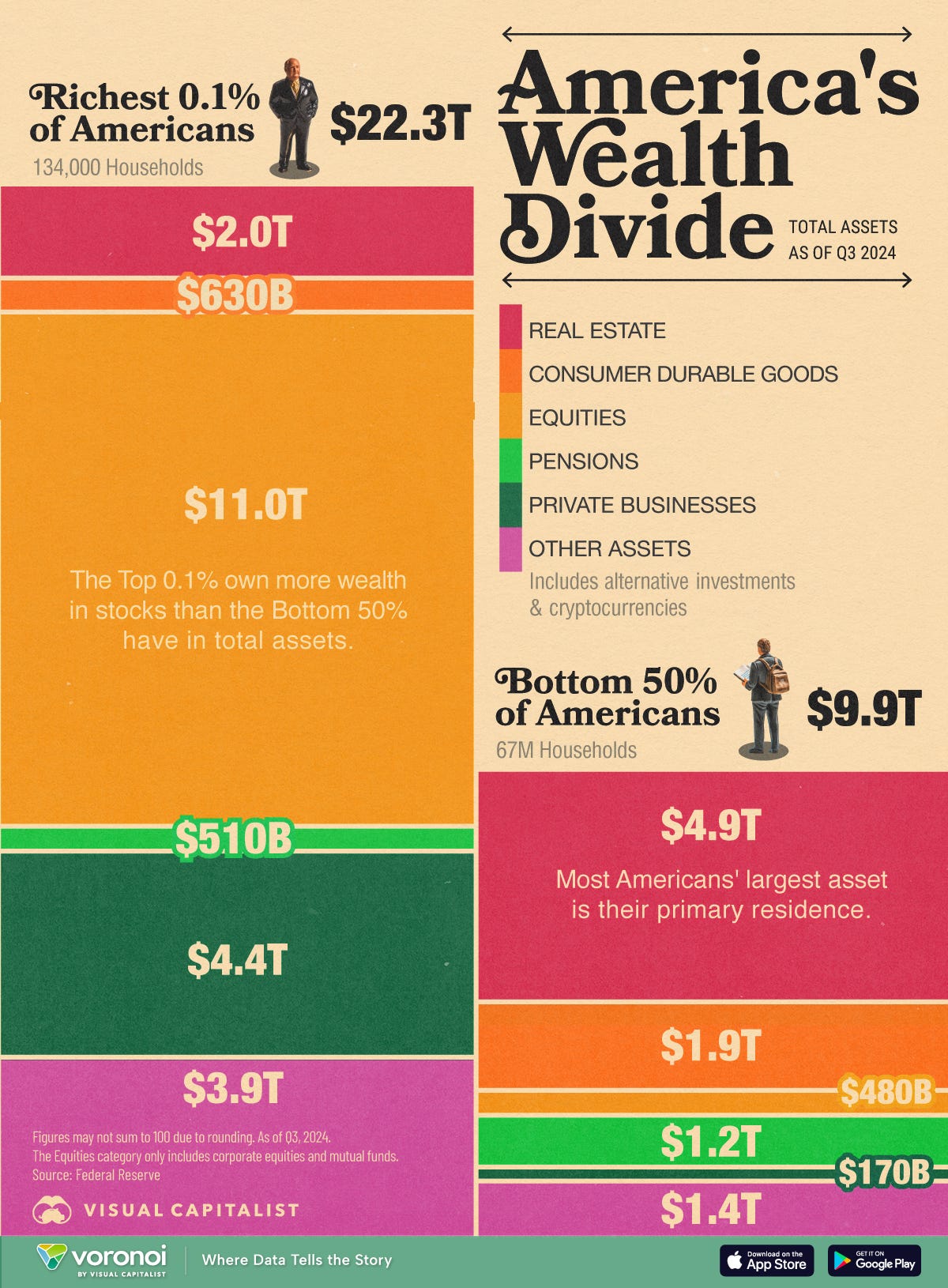
Wealth is becoming privatized
Companies are taking longer to go public and a large portion of early stage growth happens in private through venture capital or private equity with deep pockets. By the time companies trade at a 100 billion or trillion dollar valuation, the 100x opportunity is gone.
Housing is becoming increasingly expensive
Housing used to be the most consistent wealth-builder for the American middle class. Right now, it’s priced at its worst affordability ever, on record. The increase in income and purchasing power is nowhere compared to the increase in housing prices.
All of this combines to create what is called “The Great Decoupling.”
The Great Decoupling
Since the 1980s, worker pay hasn’t kept up with productivity gains. Worker productivity in the US rose about 80.9%, while average hourly compensation rose only 29.4%. So where did that extra growth go? Most of it went to corporate profits, stock ownership, and high managerial pay. When jobs could be easily outsourced, those at the top captured most of the gains.
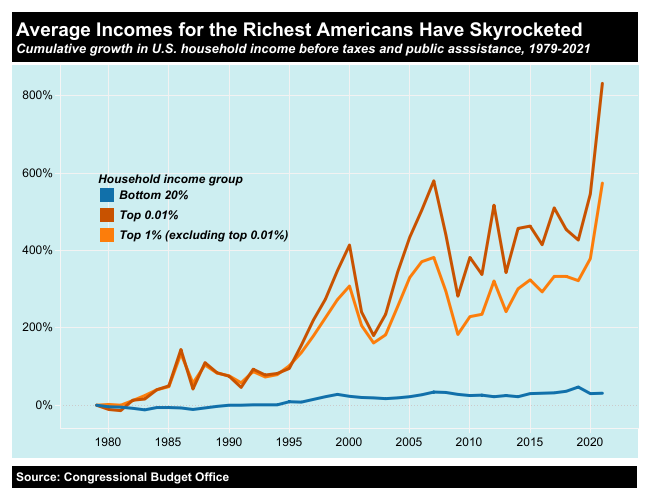
With AI being able to essentially “handle everything” in the near future, employers will have even less of an incentive to hire and train humans. But at the same time, AI also dramatically lowers the barrier to entry for small businesses.
Here’s what I expect will happen:
Smaller startups and solo entrepreneurs could leverage the power of AI to accomplish the work of larger companies with hundreds of thousands of dollars in capital.
This would lead to the creation of multi-million dollar companies that attract heavy competition, squandering the margins.
At the same time, big companies could easily deploy their capital to either duplicate the winning model or buy out the winners.
Which would bring us back to an even more concentrated economy where the “winner takes all.” But there’s a window of opportunity in which this plays out. In that window, there will be a steep divide between those who use AI and those who don’t. Those who can ride this wave will see faster promotions, higher compensation, and more negotiating leverage. This will give you more cash to invest in assets, compounding your advantage further. On the other hand, if you put it off and think you’re safe, you might be replaced by someone who does take the opportunity.
A blueprint for a golden age
The reality is that this isn’t all bad news.
Every time technologies threaten to wipe out entire industries, new industries pop up creating even more jobs:
40% of the US worked in agriculture before the 1900s. Along came tractors and fertilizers – only 2% of the US works in agriculture now, but the abundance of food let us branch into manufacturing, retail, consumer goods, and more.
Cars eliminated the need for blacksmiths, carriages, and horse breeders. But it gave way to mechanics, dealerships, highways, insurance, tourism, and personal injury attorneys.
The internet affected physical stores and print journalism, but created a whole new media industry and the ability to sell anything globally.
So if you are to take advantage of this new wave, what should you do?
Learn new skills – This doesn’t mean just learning to use AI, but also improving the areas that AI can’t replace. Personal interaction, empathy, creativity, and hands-on work. For example, even after the invention of recorded music, the demand for live music has only continued to go up. Why? People enjoy the human touch and leaning into that will be your moat.
Diversify your income – Micro-entrepreneurship is going to skyrocket by 2030, and now is the perfect time to start a side hustle of your own. Create small but predictable income streams based on niche interests that you can run by yourself because the new tools might enable possibilities that were out of your reach earlier.
Convert income to ownership: Throughout every disruption in the past, workers who invested to become “owners” pulled ahead while workers who stayed wage-only fell behind. It’s worth it to diversify across index funds and hard assets like real estate.
Lower unnecessary expenses: The people who had the biggest trouble throughout history were the ones with high fixed expenses and debt, with no margin of safety. If you’re one paycheck away from everything falling apart, it’s time to draw a budget, cut what you don’t need, avoid lifestyle inflation, keep housing costs flexible, and build a 3 to 6 month emergency fund.
And the final one: Practice deep focus.
I haven’t mentioned this one before, but uninterrupted focus is becoming a scarce commodity. If you have the ability to sit in a room for four hours without your phone, doing something productive, I’d say you’re in the top 1% of the workforce. Combine that with a consistent work ethic and continuous learning, and you give yourself a head start. Focus is what lets you capitalize on AI tools to develop your own taste and judgment, instead of churning out huge quantities of mediocre work.
Having said all that, I don’t believe this ends in doom or a sci-fi collapse where nobody works and everything falls apart.
The more realistic outcome is that AI creates enormous abundance while radically changing who captures it. In other words, prices may come down, productivity may explode, and standards of living may rise – but ownership will matter more than ever, and that’s why this 5 year window is crucial.
It isn’t a countdown to failure – it’s a head start to begin compounding your skills so that when you look back in 5 years, you could say: “I did something about it.”
If you found this breakdown helpful, please like this post and restack it. It helps the newsletter grow tremendously.
Share this with your friends who needs to understand this, to get secret rewards:
I’ll see you next week.
–– Graham
The big difference this time is that AI will effect both the lower end laborers and the white collar, high end, workers. All the other big employment changes effected low end, manual laborers. My guess is that we'll see a slow dribble of job losses until the next GFC (probably brought on by a debt crisis). After that crisis we'll see that jobs are not coming back because it will be cheaper to transition to AI rather than bring back humans.
Great article for preparing use to deal with AI. Soon are apps we are using now will be obsolete.