
The Invisible Silver Shortage
China just turned off the tap. Here's what happens next

This might be the most important topic I’ve covered in a long time. It affects the global economy. It affects the balance between countries. And it affects you as an investor. You might have seen silver rallying on the news. But it hides a darker truth.
Silver is no longer just a “precious metal.” It is the oxygen of the 2026 economy.
And the supply line is being cut before anyone can react.
If you ask the average person to picture “wealth,” they usually imagine a stack of gold bars or a vault full of cash. If you ask them to picture “silver,” they probably think of the antique forks their grandmother keeps in a storage unit.
This misconception is the single biggest blind spot in the market right now.
While the world has been fixated on the price of AI stocks, the rollout of solid-state batteries, and the Green Energy revolution, we have collectively ignored the invisible ceiling that sits above all of it. None of the technologies defining the next decade, from 5G networks to solar panels to the EVs in your driveway, can function without silver. It is the most conductive metal on earth. It has no exact substitute.
And here’s why it’s rallying: As of January 1st, the country that controls roughly 60-70% of the global processing capacity turned off the tap. Inventory is collapsing.
We aren’t just looking at a price spike. We are looking at a structural squeeze that could redefine the cost of living for the next decade.
The Commodity of You
Before we break down exactly how this supply shock plays out, we need to talk about another “invisible asset” that is being traded behind your back right now.
Just as silver is being quietly marked up by brokers, your personal data is being treated like a cheap stock. Data brokers sell your phone number, home address, and financial profile for pennies. It’s not just an invasion of privacy. It’s the direct cause of those annoying spam calls, phishing texts, and scam attempts that waste your time every single day.
You could spend hundreds of hours trying to opt out of these databases yourself. But your time is worth more than that.
DeleteMe is the high-ROI solution for 2026. Their experts automate the removal process, scrubbing your info from data broker lists and monitoring them to keep you off. It’s efficient, low-cost protection for your identity.
Get 20% off at JoinDeleteMe.com/GRAHAM with code GRAHAM

The “Grandma’s Silverware” Myth
Now back to silver: To understand why this inventory collapse is happening now, we have to unclutter our understanding of what the metal actually means.
For centuries, silver was money. Today, it’s technology.
Unlike gold, which sits idly in vaults as a store of value, silver is consumed. It’s an industrial input. Silver is more conductive than copper, gold, or aluminum.
Every time you see a headline about “Green Energy” or “AI Infrastructure,” you should really be reading “Silver Demand.” Over the last few centuries, the demand profile has shifted from aesthetic to existential:
Solar Panels: The photovoltaics industry is now consuming massive amounts of silver paste to conduct electricity from the cells.
Electronics: Every circuit board, switch, and smartphone requires it.
The New Contender: Solid-State Batteries.
This is the sleeping giant. Solid-state technology is quoted as “the next generation of battery technology,” promising faster charging and longer life. But to achieve that 700-mile range, the chemistry changes. Estimates suggest that while a current EV battery uses just 25-50 grams of silver, a solid-state battery utilizing Samsung’s new tech could require up to 1 kilogram per vehicle. That’s a 20-40x increase in demand.
When you multiply that by millions of vehicles, the math breaks.
In 2025, global demand for silver exceeded 1.24 billion ounces. The global supply was just 1.01 billion ounces. We are running a deficit, burning through above-ground stockpiles at a rate that cannot be sustained.
Why we can’t just “Dig More”
The natural question is: If the price is going up, why don’t miners just dig more silver?
This is where the economics of silver get tricky. Silver is almost never the primary target of a mine. In fact, 75-80% of all silver is produced as a byproduct of mining for other metals like copper, lead, and zinc.
This means silver supply is inelastic and dependent on other metals. You cannot just “ramp up” silver production when demand is high without ramping up copper or zinc production. If the global economy slows down and demand for lead drops, lead mines will close and the silver supply will drop, precisely when we might need it most.
On top of that, building a dedicated silver mine is a generational commitment. Even if a massive deposit was discovered today, regulatory hurdles and construction timelines mean it would take 12 to 15 years before the first ounce is refined (Crux Investor). We are stuck with the supply we have.
Enjoying this breakdown? I write this newsletter to help you uncover the hidden mechanics of the market that the headlines leave out. Join 39,000+ smart investors who get this straight to their inbox every week.
The Arbitrage Trap: West to East
This structural weakness has created one of the most dangerous arbitrage loops in modern finance.
Because China dominates the manufacturing of solar panels and EVs, their domestic demand for silver is massive. This has caused silver to trade at a significantly higher price in Shanghai compared to London or New York (Investing.com).
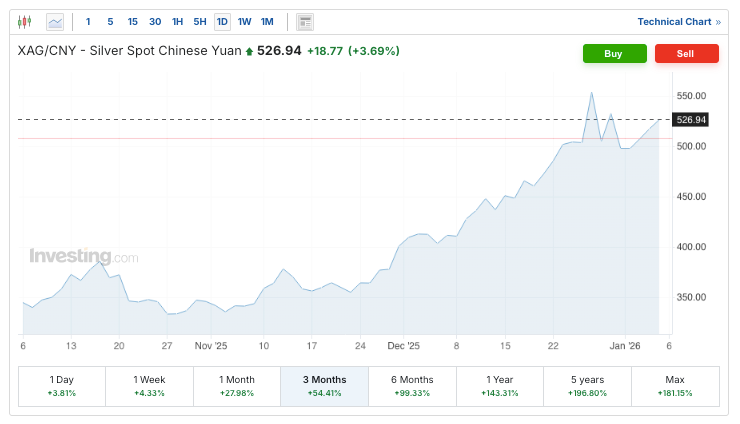
The big players noticed this gap immediately and found an opportunity. They began buying silver in the West (where it was cheap) and selling it to China (where it was expensive) to pocket the difference.
On the surface, this looks like easy profit. In reality, it’s a strategic disaster for the West. We are essentially draining our own inventory of a critical strategic resource and handing it over to a rival economy.
And now, the door has slammed shut.
The China Chokehold
As of January 1st, China has implemented a new export licensing regime. To qualify for a license, a company must produce at least 80 metric tons annually, and licenses are granted on a strict case-by-case basis. This eliminates most medium and small-sized mining companies.
Beijing can now effectively “turn off the tap” for global exports at any moment to prioritize its own needs. They have successfully cornered the world’s supply, and now they are locking the exit.
This isn’t the first time Beijing has used this playbook.
In 2010, China restricted exports of Rare Earth Elements (REEs) following a diplomatic dispute with Japan. Prices for some materials skyrocketed by over 2,000% in months, sending shockwaves through the tech and defense sectors. That move forced global manufacturers to scramble, redesign products, and plead for supply.
China knows exactly how effective a resource bottleneck can be. But unlike Rare Earths, which are a niche market, silver is embedded in almost every device in existence. This is why Elon Musk recently commented on the situation, simply stating: “This is not good.”
The Paper Illusion
If demand is at record highs, supply is inelastic, and the world’s largest processor is restricting exports, why is silver trading at $80 and not $500? Because the price you see on your screen is likely a fiction.
The financial markets trade “paper silver” which includes ETFs, futures, and derivatives. These are claims on silver, not the metal itself. The system works fine as long as everyone is happy trading paper and delays don’t imply crisis. But when confidence erodes, people start asking for the real thing.
Some analysts estimate that the paper-to-physical silver ratio is nearly 378:1. That means for every 378 shares or contracts floating around the market, there is only one ounce of physical silver in the registered vaults backing it.
This creates the potential for a huge “Short Squeeze.” If industrial buyers like Samsung, Tesla, or Apple stop trusting the paper price and demand physical delivery to keep their factories running, the banks are in trouble. They are legally obligated to deliver metal they do not have and would be forced to buy physical silver at any price, sending the value sky-high.


The Investment Verdict: Is it Too Late?
Silver is already up roughly 150% over the last year. Entering a market after a vertical run is psychologically difficult and financially risky. However, many macro-investors are looking at the Gold-to-Silver Ratio as a neutral measure for guidance.
This ratio measures how many ounces of silver it takes to buy one ounce of gold.
80: Silver is cheap (buy signal).
45: Silver is expensive (sell signal).
60: The historical average.
Today, with Gold trading at ~$4,500 and Silver at ~$80, we are sitting right around 60. Despite the massive price surge, silver is arguably fairly valued relative to gold at the moment. If gold remains stable, silver would need to hit roughly $100 to be considered “overvalued” by historical standards. But there are risks to this assumption:
Substitution: At $80/oz, the incentive for manufacturers to replace silver is massive. They’re already experimenting with copper-based electrodes for solar cells. If they succeed, industrial demand could plummet overnight.
Volatility: Silver is an industrial metal. If the global economy enters a recession in 2026, manufacturing slows down. If factories stop building cars and solar panels, they stop buying silver and demand drops. The price will crash, regardless of how “scarce” it is.
My perspective is that silver has graduated from a speculative trade to a strategic necessity. It isn’t just a precious metal: It’s a hedge against a tech-dependent future where resources are scarce.
But do not mistake this for a “safe” investment. Silver isn’t and should never be your primary investment. It could be a small part of a balanced portfolio alongside other metals like gold. Investors usually say buy gold for capital preservation, and silver for capital appreciation potential. For those that bought a few years ago, this paid off. But 2026 is likely going to show volatility that makes crypto markets look tame.
Optimizing for 2026
We just spent a considerable amount of time analyzing supply chains, export controls, and portfolio hedging. I’ve built a career on this kind of optimization, squeezing every percentage point of return out of my assets. But as I enter 2026, I’m reminded of what I wrote about last week: building a cage out of wealth.
We often spend so much time designing our portfolios that we forget to design our days. We optimize our net worth but neglect our “time worth.”
My friend Sahil Bloom said something once that hits me harder now than it did then: “Getting mega-rich is overrated. The real priority is designing a life you actually like.” That is my primary focus for this year. I am still tracking the numbers, but I am prioritizing the direction of my life first. To do that, I’m using Sahil’s framework.
He released two free PDFs:
A “Personal Annual Review” to honestly reflect on last year, and
An “Annual Planner” to design your ideal year and not just your financial goals.
If you are tired of grinding without feeling satisfied, I genuinely recommend you download them and spend 30 minutes with them this weekend. It will save you a year of drudgery.
Where does silver fit into your investment strategy? Let me know in the comments:
If you read this far, please hit the like button and share this article (it really helps!) Now you can also get rewarded for bringing in new subscribers.
Wow great article. The "China Squeeze" is real. If manufacturers like Tesla, Apple, or Samsung panic and try to secure physical delivery of silver to keep factories running, the price could disconnect from paper markets and go much higher (possibly $100+)